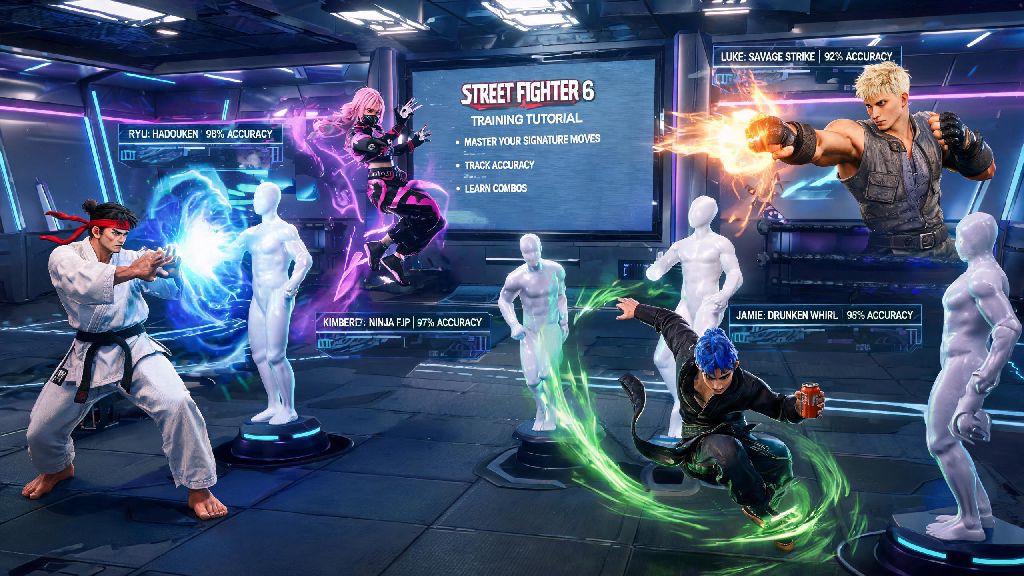
If you’ve ever loaded up Street Fighter 6 only to get completely wiped by an opponent spamming Drive Rushes and flashy supers before you can even figure out how to throw a fireball, you’re not alone. Learning a modern fighting game can feel overwhelming at first, with layers of mechanics, character-specific moves, and meta rules to wrap your head around. This guide breaks down exactly how to learn Street Fighter 6 without the frustration, with steps that work for total newbies and players coming from older fighting games alike.
Start With Core Mechanics Before Diving Into Character Specifics
It’s tempting to pick the flashiest character on the roster first, like Jamie with his drink mechanics or Kimberly with her ninja teleports, but you’ll learn far faster if you start with a well-rounded, beginner-friendly character like Ryu or Luke first. These characters have simple, easy to execute move sets that let you focus on learning Drive Gauge management and basic block and punish loops without getting distracted by character-specific gimmicks. Spend at least your first 5 hours of play sticking to basic moves, avoiding complex combos entirely.
So many new players spend hours practicing 12-hit supers only to never get the chance to use them in real matches, because they can’t even block a basic Drive Impact long enough to build the meter for it. You don’t need to know every single mechanic in the game to have fun or win matches, but mastering the core systems first will make every other skill you learn far easier to pull off when it counts. The World Tour single-player mode is a great low-pressure way to practice these basics against AI opponents that scale with your skill level.
Build Consistent Practice Routines That Fit Your Schedule
You don’t need to spend 4 hours a day playing to get good at SF6. In fact, short, daily practice sessions are far more effective than cramming 8 hours of play into one day on the weekend. Your muscle memory builds with consistent repetition, not long, exhausting marathons that leave you frustrated and burnt out. Most competitive fighting game players recommend sticking to 45 to 90 minute play sessions, with 5 minute breaks every half hour to rest your hands and reset your focus.
If you want a quick, low-stakes distraction between practice blocks that won’t take you out of the competitive headspace, you can check out IND BET, a casual short-form game platform that fits perfectly into 5-minute break windows without pulling your focus away from the skills you’re building. When building your practice routine, stick to this simple structure to get the most out of every session:
The most important rule here is focus on one skill per session. If you try to practice anti-airs, combos, and throw breaks all in one sitting, you won’t master any of them. If you spend an entire session focusing only on anti-airing every jump your opponent makes, you’ll have that skill locked in for life by the end of it. Even 20 minutes of focused practice a day will lead to noticeable improvements in just a couple of weeks.
Use Replay Analysis and Community Resources to Fix Gaps
You can play hundreds of matches and never improve if you don’t stop to look at what you’re doing wrong. Replay review is the single most underrated tool for new SF6 players, and it’s built directly into the game for free. After every match, win or lose, take two minutes to scrub through the replay and look for moments where you took unnecessary damage. Did you jump three times in a row and get anti-aired every time? Did you forget to break a throw three separate rounds in a row? Did you burn your entire Drive Gauge on a reckless Drive Impact that got blocked and punished? Those are the gaps you need to fix in your next practice session.
You don’t have to learn everything on your own, either. The Street Fighter 6 community is full of experienced players who make free guides, tutorials, and matchup breakdowns for every character on the roster. You can find character-specific Discord servers, subreddits, and content creators who specialize in teaching new players the ins and outs of their favorite fighters. You don’t have to follow community tier lists like gospel, but they can be a helpful reference if you’re struggling to pick a main that fits your play style. Don’t be afraid to ask questions in community spaces either, most long-time players are happy to help new players learn the ropes.
Adjust Your Mindset As You Learn Street Fighter 6
Fighting games are as much mental as they are mechanical, and a bad mindset will hold you back far more than slow reaction time or bad finger dexterity. So many new players quit after their first month of play because they think they’re bad at the game, when the truth is that every single pro player started exactly where you are, getting wiped by opponents who knew one more trick than they did. Don’t fixate on your rank for the first 3 to 6 months of play. Ranked is just a way to match you against players of roughly similar skill level, and early rank fluctuations are completely normal as the game figures out where to place you.
It’s far more important to focus on whether you’re executing the skills you practice in training mode during real matches, even if you lose the round doing it. If you go into a match with the goal of anti-airing every jump, and you do that even if you lose, that’s a win for your long term skill growth. Don’t get tilted when you lose to someone spamming the same move over and over. Instead, take it as a challenge to figure out how to counter that move, and you’ll walk away from the match with a new skill you can use against every other player who tries the same trick on you later.
At the end of the day, figuring out how to learn Street Fighter 6 is a personal journey, and there’s no one right way to do it. Some people pick up combo skills faster, others take longer to master mind games, and that’s completely fine. Stick to your practice routine, be kind to yourself when you lose, and focus on small, consistent improvements over time. Before you know it, you’ll be the one wiping new players off the screen with perfectly timed Drive Impacts and smooth combos you spent weeks practicing.